

An evidence-led investigation into property prices, foreign investment, EU accession and investor confidence.
Rezidenca.al | Real Estate Insights & Investment | October 19, 2026
Albania’s real estate market is entering a decisive period. Following several years of rapid price appreciation, growing foreign demand and ambitious luxury developments, the country now faces a more complex environment characterized by moderating property-price growth, political uncertainty and continued progress toward European Union membership.
Three developments are intersecting:
- Political uncertainty: Demonstrations initially associated with opposition to a controversial luxury coastal development have expanded into broader concerns about education, living costs and governance, as reported by Reuters on October 15, 2026.
- European integration: Albania provisionally closed another EU accession chapter on October 13, bringing its total to four of 33, according to the European Commission.
- A changing property market: Annual residential price growth slowed to 10% in the first half of 2026, compared with 41.7% a year earlier, according to the Bank of Albania survey reported by RTSH.
These developments raise a question for domestic and international buyers:
Can Albania’s real estate market maintain its attractiveness while the country’s political and institutional environment faces greater scrutiny?
1. The Numbers Behind Albania’s Changing Property Market
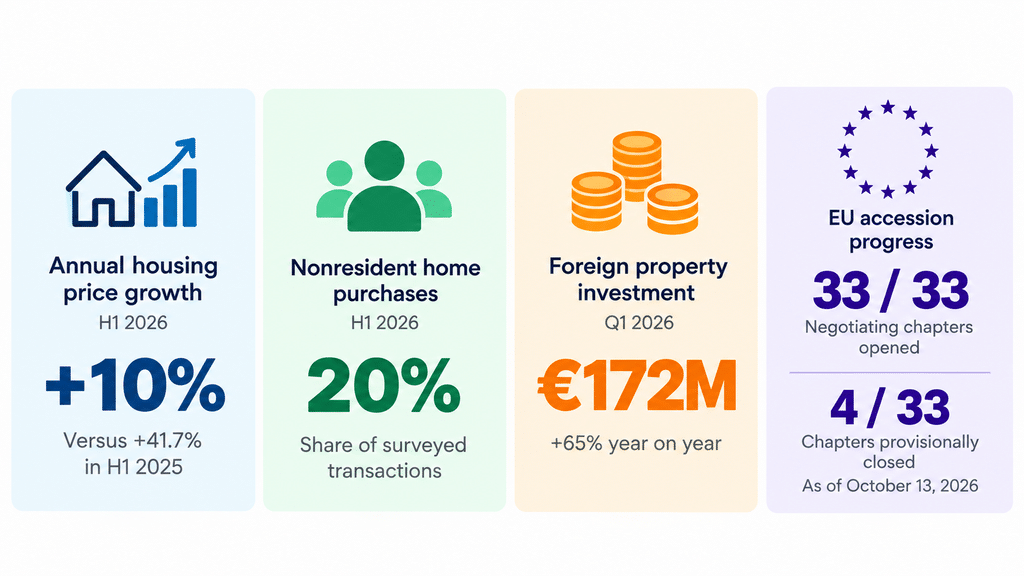
Albania has reached an important milestone in its European integration process, having opened all 33 EU accession negotiating chapters. Four chapters have been provisionally closed as of October 13, 2026. During her September visit to Tirana, European Commission President Ursula von der Leyen welcomed Albania’s progress while emphasizing the importance of continued reforms.
Official source: European Commission — October 13, 2026.
According to the Bank of Albania’s survey of property market participants, residential price growth slowed substantially over the past year.
Albanian housing price growth is slowing
Annual change in the Fisher House Price Index
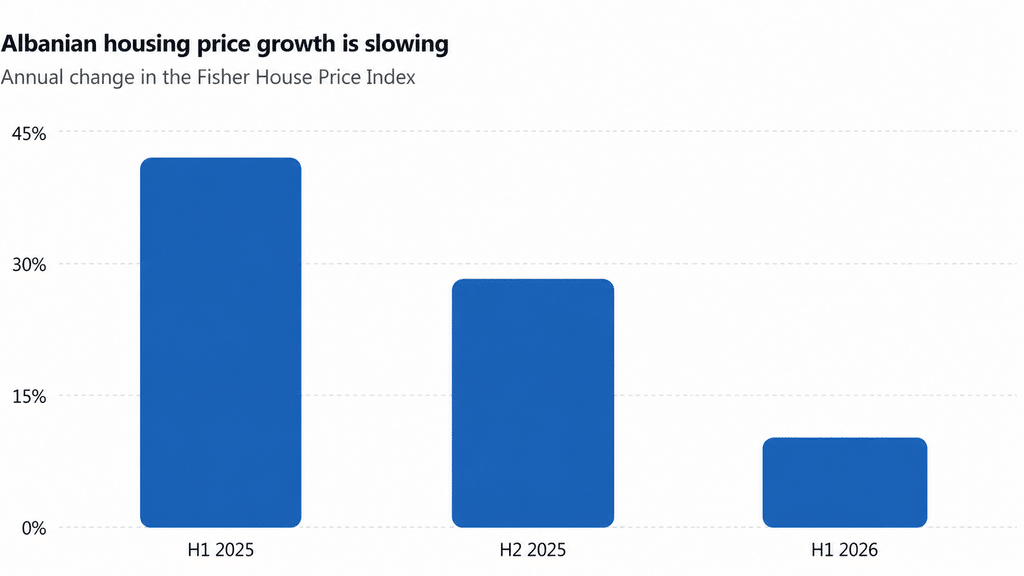
Figure 1. Year-on-year Fisher House Price Index growth. Source: Bank of Albania real estate market survey, reported by RTSH, September 24, 2026.
The slowdown does not mean that the market has entered a nationwide price correction. In fact, the national price index was unchanged in the first half of 2026 compared with the preceding six months.
Tirana continued to show different dynamics, with prices increasing by approximately 10% compared with the second half of 2025.
This suggests an increasingly differentiated market, where location, quality, supply and buyer purchasing power may play a greater role in determining valuations.
For investors, the distinction between slower price growth and falling prices is essential.
2. Foreign Investment Remains an Important Market Driver
International investment continues to support Albania’s real estate sector.
In the first quarter of 2026, foreign investment in Albanian property reached approximately €172 million, representing a 65% increase from the same period in 2025.
Real estate accounted for approximately 43% of Albania’s total foreign direct investment during that quarter, according to figures published by RTSH on June 25, 2026.
The Bank of Albania’s market survey also indicates that nonresidents represented approximately 20% of residential purchases in the first half of 2026, with European Union citizens accounting for around 85% of those nonresident buyers.
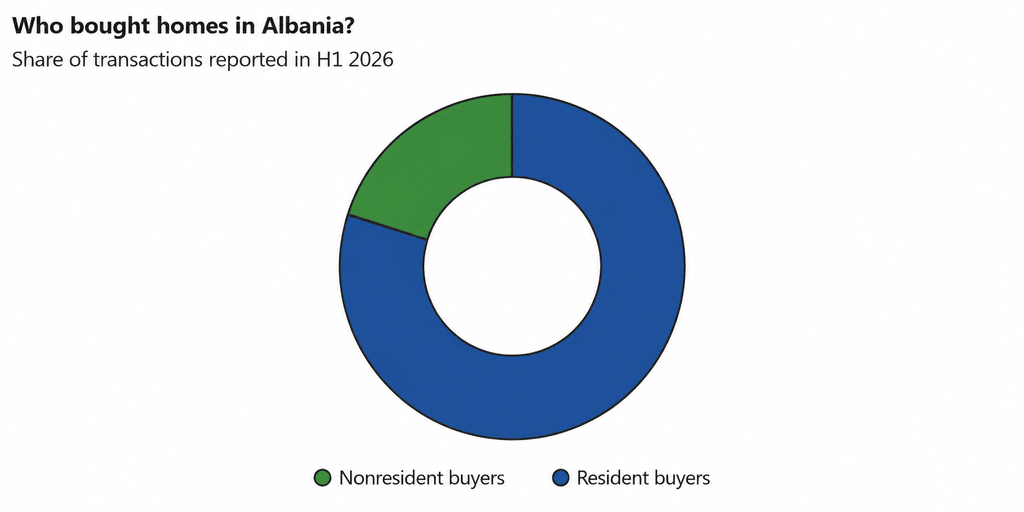
Figure 2. Approximate share of residential transactions by buyer residency, not share of total invested capital. Source: Bank of Albania survey, RTSH, September 24, 2026.
Foreign buyers are attracted by Albania’s Mediterranean coastline, tourism potential, new residential developments and its position as an emerging European property destination.
However, increased international exposure also raises expectations regarding transparency, ownership documentation, construction standards and regulatory predictability.
The long-term challenge for Albania is therefore not merely to attract capital, but to maintain confidence in the market where that capital is invested.
3. Political Uncertainty and the Question of Investor Confidence
Recent developments have introduced an additional variable into Albania’s economic landscape.
A movement initially associated with environmental objections to a proposed luxury tourism project near Vlora expanded during 2026 into demonstrations addressing a wider range of national concerns.
As reported by Reuters on October 18, 2026, the demonstrations have become a significant domestic political issue at a time when Albania is pursuing closer integration with the European Union.
For the real estate market, the relevance is primarily institutional and economic.
Property investments involve long-term commitments. Developers need dependable planning procedures, buyers need clear ownership rights, and investors require confidence in legal and administrative processes.
Public scrutiny of large coastal development projects raises questions around environmental safeguards, land ownership and the approval of major investments.
These concerns do not automatically imply that Albania’s real estate market is becoming less attractive.
Indeed, stronger standards and greater transparency may benefit the sector over the longer term.
The crucial distinction is between temporary political uncertainty and structural changes that affect the operating environment for property investment.
There is currently no sufficient evidence to establish a direct causal relationship between the October demonstrations and a nationwide decline in property prices or foreign investment.
4. Tirana and the Albanian Riviera: Different Markets, Different Opportunities
Albania’s residential property market encompasses several distinct segments.
The differences are reflected in the time required to sell properties.
According to the Bank of Albania survey, the national average selling period rose from 9.1 to 9.9 months. In Tirana, it increased from 8.1 to 9.7 months.
Coastal areas followed a different trajectory, with the average selling period decreasing from 9.9 to 8.2 months.
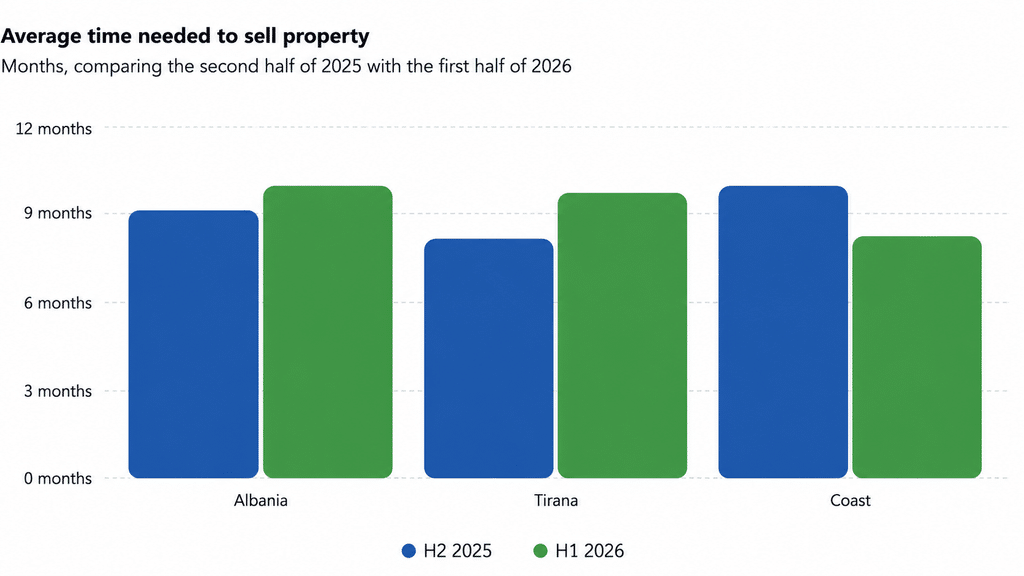
Figure 3. Average reported selling times. Source: Bank of Albania survey, RTSH, September 2026.
While these results do not establish why coastal properties sold more quickly, they reinforce the importance of evaluating local markets separately.
In the luxury segment, factors such as sea views, construction quality, infrastructure, environmental surroundings, legal documentation and property management services may increasingly determine how individual assets perform.
5. EU Accession: A Potential Long-Term Advantage
On October 13, 2026, the European Union and Albania provisionally closed negotiations on Chapter 20, covering enterprise and industrial policy.
This brought Albania’s total to four provisionally closed chapters out of 33, all of which have been opened, according to the European Commission’s official announcement.
For real estate investors, the accession process may be significant because it encourages reforms in areas such as the rule of law, administrative capacity, environmental standards and market regulation.
More consistent implementation of these standards could improve legal certainty and reduce certain risks associated with cross-border investment.
However, EU membership is not guaranteed, and accession should not be interpreted as an automatic driver of higher property prices.
The potential benefit is a more predictable institutional environment supporting sustainable investment over the long term.
6. Albania Real Estate Outlook 2027: Three Possible Scenarios
The available evidence does not justify a single confident forecast. Three scenarios help illustrate how the market might evolve.
| Scenario | Possible characteristics |
|---|---|
| Stabilization | Moderate price growth, steady foreign demand and greater emphasis on property quality |
| Renewed growth | Stronger foreign investment, continued tourism expansion and increased residential demand |
| Increased uncertainty | More cautious buyers, delayed projects and stronger differentiation between property segments |
The outcome will depend on a combination of economic conditions, financing costs, housing supply, institutional developments and international investor sentiment.
Rather than reacting to individual political events, investors may benefit from following measurable indicators including property prices, selling times, foreign direct investment and the progress of major regulatory reforms.
7. What Buyers and Investors Should Watch
For those considering property investment in Albania in 2027, due diligence remains essential.
The most relevant considerations include clear ownership documentation, verified building permits, reputable developers, infrastructure quality, environmental restrictions and realistic rental or resale expectations.
Buyers should also distinguish between asking prices and completed transactions, particularly when evaluating premium residences or properties in rapidly developing coastal locations.
Albania may continue offering attractive opportunities, but these should be assessed individually rather than based on assumptions of guaranteed capital appreciation.
Conclusion: A Market Entering a More Selective Phase
Albania approaches 2027 with a property market characterized by sustained international interest, moderating price growth and a changing institutional environment.
Recent political developments introduce uncertainty, but they also highlight the importance of transparency and long-term planning.
Meanwhile, continued progress toward European integration offers a potential foundation for stronger standards and greater investor confidence.
The challenge for Albania is to translate its geographic advantages, tourism appeal and international visibility into sustainable property-market development.
The defining question for 2027 may not be how quickly real estate prices rise, but how sustainably Albania’s property market can grow.
For buyers, developers and investors, this means looking beyond short-term headlines and focusing on quality, legal certainty and lasting value.
About Rezidenca.al
Rezidenca.al is an independent Albanian real estate listing platform connecting buyers, owners, developers and real estate professionals. Through property listings and market insights, the platform aims to support informed decisions within Albania’s evolving property market.
Editorial note: Data and developments referenced are current to October 19, 2026. Market scenarios are illustrative, not investment forecasts. This article does not constitute financial or legal advice.


